
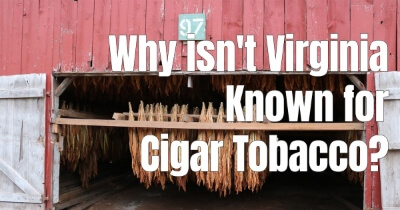
Despite its deep-rooted connection to the tobacco industry, Virginia is conspicuously absent from the list of prominent cigar tobacco producers. On New Years Eve, I was introduced to a Biology professor that shared his concern for legacy sediment with me while we discussed the Connecticut River Valley. Over a Davidoff Small Batch #3, the topic came up about why Virginia isn’t known for cigar tobacco like Connecticut, Pennsylvania, and nowadays Florida. I had to do some more digging, because I wasn’t satisfied with my answers since Virginia is no stranger to tobacco.
Types of Tobacco Virginia is Known For
Virginia is actually known for producing high-quality flue-cured tobacco, which is commonly used for cigarette blends and some pipe tobaccos. However, when it comes to wrapper tobacco, which is the outer leaf used to cover cigars, Virginia does not currently play a prominent role.
Depending on the desired crop, the seeds used for cigarette and cigar tobaccos aren’t necessarily different. A quick google shows that the average elevation and humidity in Virginia are similar to Connecticut while the average temperatures during the growing season are more favorable — which begs the question, why is Virginia not a major player in tobacco used for cigars?
If it’s not the soil, elevation, humidity, or temperature that stops Virginia from growing wrapper-grade tobacco, it has to be the cultivation process, curing methods, and infrastructure. The type of curing that Virginia is known for is a completely different animal from the tobacco farmers selling their crops to cigar factories.
Flue-Cured Tobacco (Mostly Cigarettes and Pipe Tobacco)
The curing process for flue-cured tobacco involves hanging the harvested leaves in barns with flues (pipes) that provide controlled heat. This process helps to preserve the bright color of the leaves and high sugar content, resulting in a milder, smoother flavor suitable for cigarettes.
Sugar and nicotine are inversely correlated at this stage; the darker leaves that cigar tobacco is known for results in higher nicotine and less sugar. The flue-curing process allows for various combustion and flavor differences by turning up the heat at different times in the process. If you’ve ever enjoyed a Candela (bright green) cigar, the wrapper leaf was flue-cured to quickly reduce the moisture content of the tobacco while maintaining in the color.
Virginia is practically synonymous with flue-cured tobacco, and even Philip Morris identifies flue-cured tobacco as Virginia tobacco. Funny enough, Philip Morris also notes that Virginia tobaccos are grown in Argentina, Brazil, China, India, and Tanzania as well, giving the curing process more weight than the geography (not unlike Connecticut is used to describe the color of a cigar rather than its origin these days).
Air-Cured Tobacco (Mostly Cigars and Pipe Tobacco)
Cigar wrapper leaves are air cured, taking anywhere from four to twelve times longer to cure the tobacco. Flue-curing tobacco happens in less than a week whereas air curing takes between one and four months.
Typically, air-cured barns have vents that can be opened and closed to achieve the desired amount of humidity and temperature. This is important because the aim of curing tobacco is to achieve uniformity throughout process, ensuring the leaves cure together. Flue-cured barns, on the other hand, are much more high-tech since the process is quicker and needs to be more regimented.
Both methods of curing tobacco seek to manage temperature, humidity, and time variables to achieve the desired result. The time commitment and equipment, however, is radically different between the two.
Final Thoughts
After the last 24 hours of research, there’s no doubt in my mind that Virginia could produce wrapper-grade cigar tobacco if Virginians wanted to. But they’re already known for producing some of the world’s finest pipe tobacco and are a staple in cigarette tobacco.
The transition would require an overhaul of equipment and infrastructure, presenting the largest barrier for Virginia that I am aware of. And with other countries like Nicaragua, the Dominican Republic, Ecuador, Cameroon, Costa Rica, Peru, and Indonesia already producing tobacco for cigars at a fraction of the cost, I doubt we’ll see a Virginia wrapper any time soon.
As always, if you have more to contribute to the topic please drop a comment below!


Leave your comment