
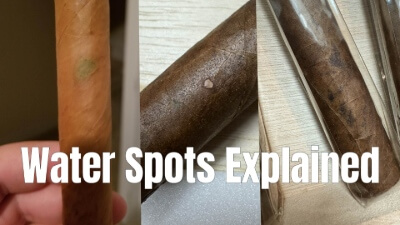
Cigar water spots have been the talk of the town lately, and I wanted to address it in a comprehensive article breaking it down. But I had one problem: I couldn’t back up my assumptions with research. As it turns out, there are multiple types of water spots found on tobacco leaves that can occur from the farm, the curing barn, or during the fermentation process.
To reconcile my lack of knowledge, I approached several people in the industry to help me get a better understanding of the causes so I can pass it along. The most helpful of these contributors for water spots and sun spots were Steve Saka, Klaas Kelner, and Hostos Quesada. Many thanks to these gentlemen for generously sharing their information!
When I reached out to Klaas, his first response was, “What is a water spot to you?” Similarly, rather than reply by email, Steve said that it was best to chat on the phone. This goes to show how much confusion surrounds this topic in the cigar world, and hopefully we can make more sense of it today with their help.
It’s important to note that water or sun spots are completely harmless and do not affect the flavor or performance of a cigar in any way. Tobaccos under the hood of a cigar may have water or sun spots, we just can’t see them because the wrapper is all that the average cigar enthusiast gets to preview.
Wrapper leaf is by far the most expensive leaf in a cigar because it’s grown to be as pristine as possible, meaning great care is taken at the farm and factory level to reduce blemishes. But, since these spots do not affect the flavor of a cigar, sometimes they slip through.
Sun Spots Occur in the Growing Phase
Sun Spots occur during the growing process and are small, pale, circular marks that appear on the wrapper leaf. When water droplets rest on a leaf’s surface at the exact right time, they act as miniature lenses, focusing sunlight onto specific points. This concentrated beam of light can cause a slight bleaching effect, resulting in distinctive spots.
Although I can’t be sure of the exact reason, Cameroon wrappers tend to exhibit more sun spots than other wrapper leaves. Cameroon tobacco has its own challenges from a less industrialized growing region to less availability, probably resulting in less rejections to keep costs lower. This particular variety of wrapper leaf is also very thin, which may make it easier for sun spots to occur naturally.
Water Spots Occur at the Curing Phase
Water spots are typically identified by having a greenish hue in a small area of the wrapper leaf. It doesn’t have a distinctive line around the edges and almost looks brushed on. These spots are most visible on lighter shades of tobacco leaves, but can rarely be found on darker wrapper leaves.
Water spots occur in the curing stage of tobacco. The goal of curing is to always uniformly dry the leaf out, but this is much easier said than done. If due to excess heat or abnormal humidity the leaves aren’t able to shed all of their chlorophyll, you end up with a water spot.
On a macro scale, this is how a candela wrapper is made. The curing process is much faster and hotter, locking in the chlorophyll of the leaf to maintain the tobacco’s green color.
Mancha Stains Occur in the Fermentation Phase
Many thanks to Steve Saka for introducing me to this new term for water blemishes that occur during the fermentation phase. Mancha stains appear as (often dark) streaks on the wrapper leaf and lack a uniform appearance.
This makes sense to me because of how some tobaccos undergo additional fermentation to create a Maduro wrapper. In this case, however, it is a less-than-perfect fermentation that creates these dark streaks. Given how tobacco leaves are fermented in large pilones with significant man hours involved, I’m surprised we don’t see more of these streaks overall.


Leave your comment